






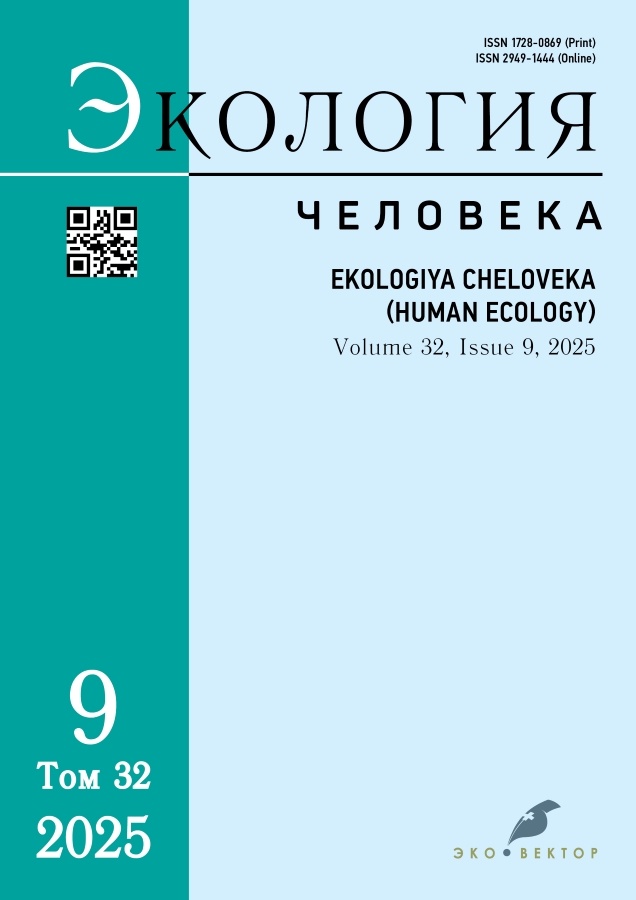
Ekologiya cheloveka (Human Ecology)

Peer-review monthly academic journal.
About
Human Ecology is a monthly peer-reviewed Open Access journal with the main focus on research and practice in the fields of human ecology and public health.
The journal publishes original articles, review papers, and educational materials on research methodology.
The primary audience of the journal includes health professionals, environmental specialists, biomedical researchers and post-graduate students.
Editor-in-Chief
- Tatiana N. Unguryanu, MD, PhD.
ORCID: 0000-0001-8936-7324
Publisher
- Eco-Vector
https://eco-vector.com/
Publications
- monthly issues
- continuous publication in Online First (Ahead-of-Print)
- immediate Open Access with CC BY-NC-ND 4.0 International license.
- articles in Russian and English
Indexation
- SCOPUS
- Google Scholar
- Ulrich's Periodicals directory
- Russian Science Citation Index (Web of Sciences)
- Norwegian National Center for Research Data
- VINITY
- Global Health
- CAB Abstracts
- ProQuest
- InfoBase Index
- EBSCO Publishing (EBSCOhost)
- CyberLeninka
The journal is registered with the Federal Service for Supervision of Communications, Information Technology and Mass Media and Federal Service for Monitoring Compliance with Cultural Heritage Protection Law PI № FS77 - 78166 from 20 March 2020


Current Issue
Vol 32, No 9 (2025)
- Year: 2025
- Published: 27.10.2025
- Articles: 6
- URL: https://hum-ecol.ru/1728-0869/issue/view/12991
Full Issue

НАУЧНЫЙ ОБЗОР
Modern scientific and methodological approaches to monitoring water bodies and wastewater: a review
Abstract
This review of scientific and methodological approaches to monitoring water and wastewater was conducted to address the issues of environmental safety of water, population access to high-quality drinking water, and wastewater as a major anthropogenic pollutant. The scientific data search was performed in the PubMed biomedical database, the Russian scientific electronic library eLIBRARY.RU, and the official websites of scientific journals with thematic sections on the subject. The search included publications from 15 years. Despite numerous studies demonstrating the advantages of automated monitoring systems—which, while costly, enable real-time control of water bodies—state monitoring of water quality still relies on traditional methods. These are characterized by complexity, high maintenance costs of laboratory equipment, the use of chemical reagents, longer testing times, and limited applicability for on-site and real-time monitoring. Under these conditions, a unified automated system for monitoring the ecological and hygienic status of aquatic environments and wastewater treatment would considerably improve water body protection. This would ensure the supply of safe drinking water to the population and the optimal use of water in health resorts and recreational zones.
Legislative action is required to establish a unified, integrated approach that enables real-time identification of water pollution sources, locations, and levels, as well as mapping of the ecological and hygienic status of water bodies.
 616-627


ORIGINAL STUDY ARTICLES
Assessment of the pathogenicity of weather and climatic conditions in the Kamchatka Territory
Abstract
BACKGROUND: Climate is one of the most important factors shaping human habitat and health. Given the significance of climate at the macro- and meso-levels, regional-level studies of weather and climatic conditions for medical purposes are particularly relevant. The choice of the Kamchatka Territory for this research is explained by the insufficient knowledge of regional medical and climatic conditions and the need to protect public health.
AIM: This study aimed to provide a regional assessment of the pathogenicity of weather and climatic conditions in the Kamchatka Territory.
METHODS: The study was based on meteorological data from 2010–2024 collected from meteorological stations covering all climatic subregions and administrative districts of the territory. The assessment was carried out using a composite bioclimatic index (weather pathogenicity index), with the construction of time series for mean annual values and annual cycles. To evaluate the spatial distribution of the index, a series of maps was developed. In addition, correlation analysis was performed between index values and overall population morbidity.
RESULTS: Almost homogeneous variation of mean annual index values was identified across the territories of Kamchatka. This reflects the stability of weather and climatic conditions, as well as seasonal and territorial differences in their pathogenicity. Increasing pathogenicity was observed along the main gradient from southeastern and central to northern areas. In the warm season, differences between continental and coastal areas were more pronounced, with the former showing the most favorable (optimal) values of the index across the territory. In the cold season, especially in January, acute pathogenicity was observed throughout the region. The greatest number of correlations was established between morbidity rates and index values during the cold season (with a strong association for respiratory diseases).
CONCLUSION: This study provides the first assessment of the pathogenicity of weather and climatic conditions in the Kamchatka Territory. A relatively stable spatiotemporal differentiation of pathogenicity was identified. The most suitable and unsuitable areas were determined for implementing medical, sanatorium–resort, and tourism–recreational activities. The most favorable areas were central inland territories, whereas the least suitable were Bering Island and the southwestern coast of Kamchatka.
628-639
Morbidity characteristics of pregnant women in Eastern Siberia: a retrospective epidemiological study
Abstract
BACKGROUND: Among the indicators of women’s reproductive health, morbidity rates during pregnancy hold particular significance.
AIM: The work aimed to assess the prevalence of diseases complicating pregnancy in the Irkutsk Region during the period 2005–2023.
METHODS: Study design: retrospective descriptive epidemiological study. Data sources: Rosstat databases and statistical digests Key Indicators of Maternal and Child Health, Activities of Child Welfare and Obstetric Care Services in the Russian Federation. Trends in morbidity indicators were identified by analytical smoothing of time series using a linear least squares model with standard Microsoft Office 2007 tools and IBM SPSS Statistics 23.
RESULTS: From 2006 to 2023, substantial changes occurred in the pattern of morbidity among pregnant women: the prevalence of genitourinary system infections decreased (by a factor of 1.36 in the Russian Federation and 1.65 in the Irkutsk Region), as did that of circulatory system diseases (by a factor of 1.85 in the Russian Federation and 2.82 in the Irkutsk Region). The prevalence of endocrine system diseases was variable; however, in 2019–2023 it showed a steady upward trend: in the Russian Federation from 9.29% to 11.47%, and in the Irkutsk Region from 11.34% to 13.03%. The most pronounced negative trend was observed for gestational diabetes mellitus: between 2014 and 2023, its prevalence among pregnant women increased sharply—from 1.33% to 11.38% in the Russian Federation and from 1.31% to 13.58% in the Irkutsk Region.
CONCLUSION: In the Irkutsk Region and in the Russian Federation as a whole, the first quarter of the 21st century has been marked by a high prevalence of diseases among pregnant women. This underscores the need for further improvement of preventive measures, development of advanced medical technologies for maternal care, and expansion and refinement of screening programs. Particular attention should be given to reducing the prevalence of anemia, endocrine system diseases, and gestational diabetes mellitus.
640-650
Relationship between variations in population health disorders in a subarctic region and heliogeophysical factors and oxygen status of surface air under different levels of solar activity
Abstract
BACKGROUND: It is generally recognized that human health depends on the changes of space weather. However, the cyclic interactions of specific groups of diseases with the main components of solar radiation and its derivatives remain unresolved.
AIM: The work aimed to assess the stability of time series of health disorders in the northern population, as well as linear and phase synchronization with heliogeophysical factors and oxygen status depending on the level of solar activity.
METHODS: Data on sunspot numbers were obtained from the Royal Observatory of Belgium. To assess the level of solar radiation, as well as planetary and local indices of magnetic activity, materials from the All-Russian Research Institute of Hydrometeorological Information were used. Partial oxygen density was calculated from values of temperature, atmospheric pressure, and relative humidity. Data on ambulance calls were retrieved from the emergency service database. Indicators from 2001 and 2007 (years of high and low solar activity, respectively) were compared. Wavelet analysis was applied for mathematical processing.
RESULTS: In the overall ambulance call dataset, the degree of data dispersion in 2001 was 14.69%, compared with 15.83% in 2007; in men, the indicator was 25.78% and 24.40%, respectively, and in women 23.75% and 23.23%, independent of solar activity level. The temporal distribution of cases of infectious diseases, mental disorders, genitourinary pathology, pregnancy, and childbirth became heterogeneous with increasing solar activity, whereas for respiratory diseases a consolidation of the time series was observed. Linear synchronization was characterized by a moderate positive association (0.338) between ambulance calls and partial oxygen density, which decreased to a weak level (0.177) with rising solar activity; linear synchronization with sunspot numbers (0.139), solar radiation (0.278), and the local magnetic activity index (0.119) weakened to the level of statistical noise during high solar activity. In the active Sun year, the in-phase synchronization index of total ambulance calls increased with the number of sunspots (57.4% in 2001; 61.1% in 2007) and solar radiation (55.6% 2001; 60.4% in 2007), whereas synchronization between calls and partial oxygen density declined (77.2% 2001; 68.5% 2007). Assessment of phase desynchronization between heliophysical factors and specific nosological groups revealed three reaction types: absence of reaction, synchronization, and desynchronization.
CONCLUSION: With increasing solar activity, the temporal distribution of ambulance calls becomes heterogeneous for infectious diseases, mental disorders, genitourinary pathology, pregnancy, and childbirth. In the case of respiratory diseases, the opposite effect is observed in the form of time series consolidation. In a year of the quiet Sun, moderate linear synchronization exists between ambulance calls and partial oxygen density, which declines to weak synchronization with increasing solar activity, accompanied by pronounced sex-related differences. Associations of health disorders with sunspot numbers, solar radiation, and planetary and local magnetic activity indices weaken to statistical noise during active Sun periods. With increasing solar activity, phase desynchronization is observed between fluctuations in health disturbances and the variability of oxygen partial density. Desynchronization of health rhythms is observed only in relation to global planetary parameters. When comparing time series of ambulance calls stratified by nosological groups with the locally calculated magnetic activity index and partial oxygen density, phase desynchronization was found to decrease.
651-660
Influence of anthropometric and body composition parameters on handgrip strength in middle-aged and older adults in the Russian Arctic
Abstract
BACKGROUND: Age-related decline in muscle strength is associated with metabolic changes and has a significant impact on performance status and quality of life in older adults. Sarcopenia is caused by a combination of sociodemographic, behavioral, physiological, and climatic factors, underscoring the relevance of studying predictors of muscle strength decline in populations living in unfavorable natural and climatic conditions of Russia’s European North.
AIM: The work aimed to assess the influence of sociodemographic characteristics, lifestyle factors, anthropometric measures, and body composition parameters on handgrip strength in middle-aged and older adults residing in the Russian Arctic.
METHODS: The study used data from two cross-sectional population-based studies conducted 7.2 years apart in a single random sample of the adult population of Arkhangelsk (n = 1168). Associations between handgrip strength and sociodemographic characteristics, lifestyle factors, anthropometric measures, and body composition parameters were assessed cross-sectionally and longitudinally using linear and logistic regression analysis.
RESULTS: Cross-sectional analyses revealed an age-related decline in handgrip strength in both men and women, with a greater reduction in men. Handgrip strength was positively associated with height, body mass index, waist circumference, and waist-to-height ratio, as well as with higher education in men. Lower handgrip strength was associated with smoking in men and financial difficulties in women. According to bioimpedance data, higher basal metabolic rate and fat mass percentage were associated with greater handgrip strength, whereas higher muscle mass percentage and body impedance were linked to lower strength. Patterns observed cross-sectionally were partially confirmed in longitudinal data. Greater height, general and abdominal obesity parameters, and higher basal metabolic rate were associated with a lower risk of decline in handgrip strength over time in women, whereas older age, greater body impedance, and higher proportions of muscle mass and body water increased the risk. In men, older age was associated with a higher risk of strength decline, whereas greater height reduced the risk.
CONCLUSION: Handgrip strength in middle-aged and older adults was determined by a set of sex-specific factors. Longitudinal decline in handgrip strength was more strongly associated with anthropometric and body composition parameters than with sociodemographic or behavioral factors. These findings highlight the importance of considering sex-specific differences when developing sarcopenia prevention strategies for residents of the Russian Arctic.
661-674
Parameters of free radical oxidation in women of different ethnic groups in menopause living in urban and rural areas of the Baikal region
Abstract
BACKGROUND: The course of menopause may acquire a pathological trajectory, leading to the development of associated disorders and the formation of climacteric syndrome. The predisposition to pathological conditions can be assessed through evaluation of nonspecific lipid peroxidation processes. It is known that these processes can be influenced by various factors, including ethnicity of the subjects, whereas the impact of place of residence remains poorly studied.
AIM: This study aimed to assess the parameters of free radical oxidation and antioxidant defense in menopausal women of Russian and Buryat ethnic groups living in urban and rural areas of the Baikal region, in order to determine the impact of territorial factors of this region on the local population.
METHODS: The study included 344 women in the climacteric period, divided into four groups: Russian ethnic group, urban (n=115); Russian ethnic group, rural (n=43); Buryat ethnic group, urban (n=129); Buryat ethnic group, rural (n=57). In all women, lipid peroxidation parameters were measured: the levels of substrates with isolated double bonds, diene conjugates, ketodienes and conjugated trienes, and thiobarbituric acid reactive substances. Assessment of antioxidant defense components included determination of superoxide dismutase activity, total antioxidant activity of blood, concentrations of α-tocopherol and retinol, levels of reduced and oxidized glutathione, and calculation of their ratio. Differences were considered significant at p <0.05.
RESULTS: Russian women living in rural areas had higher levels of substrates with isolated double bonds (p=0.013), diene conjugates (p=0.018), ketodienes and conjugated trienes (p=0.047), thiobarbituric acid reactive substances (p=0.011), superoxide dismutase activity (p <0.001), and oxidized glutathione (p=0.006), along with lower retinol levels (p=0.001), reduced glutathione (p <0.001), and the reduced/oxidized glutathione ratio (p <0.001), compared to urban residents. Among Buryat women in rural areas, higher levels of substrates with isolated double bonds (p <0.001), diene conjugates (p=0.001), ketodienes and conjugated trienes (p =0.001), thiobarbituric acid reactive substances (p <0.001), superoxide dismutase activity (p = 0.009), α-tocopherol (p=0.043), and oxidized glutathione (p=0.008) were observed compared to urban residents. Ethnic differences were identified only among urban women, with Russian women showing higher values of ketodienes and conjugated trienes (p=0.008), thiobarbituric acid reactive substances (p <0.001), α-tocopherol (p <0.001), retinol (p <0.001), reduced glutathione (p <0.001), and the reduced/oxidized glutathione ratio (p <0.001).
CONCLUSION: The ecological characteristics of the Baikal region exert a significant influence on the state of free radical homeostasis in menopausal women of the region’s major ethnic groups.
675-687

Регистрационный номер и дата принятия решения о регистрации СМИ: серия ПИ № ФС 77 - 78166 от 20.03.2020.